Cost Segregation
Studies in Minnesota
Most investors leave five figures on the table every year by depreciating real estate the slow way. Cost segregation fixes that — legally, IRS-sanctioned, and often in the same tax year you buy.

What Is Cost Segregation?
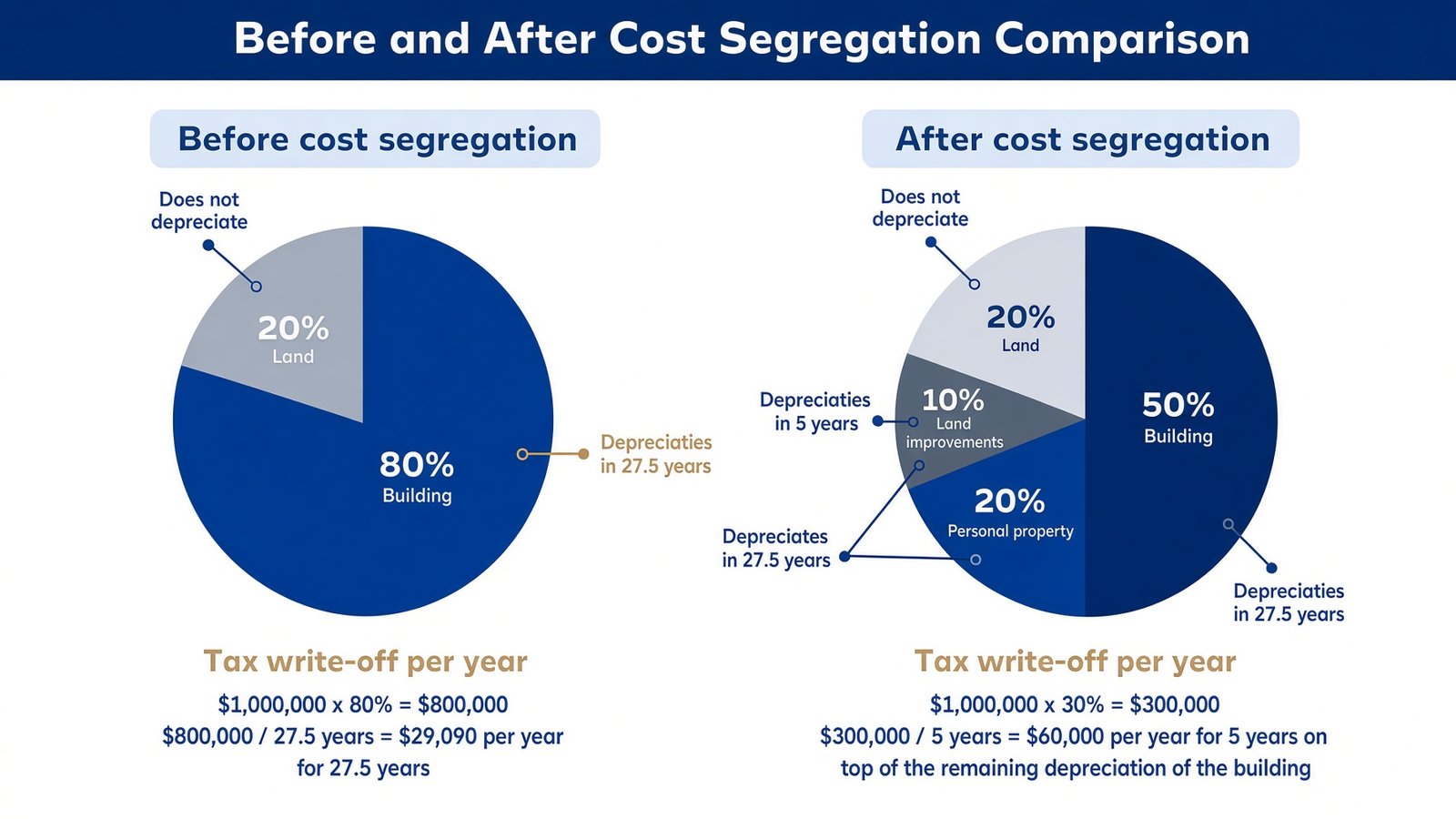
When you buy an investment property, the IRS normally requires you to depreciate the entire building over 27.5 years (residential) or 39 years (commercial). A cost segregation study breaks the property into components — flooring, cabinetry, wiring, landscaping, parking — and reclassifies them into shorter depreciation schedules of 5, 7, or 15 years.
The result: a much larger depreciation deduction in years 1–5, which reduces your taxable income — and your tax bill — right now instead of spread over decades.
÷ 27.5 years
= $18,182/yr deduction
~25% reclassified
= $40,000–$60,000 Year 1
Who Benefits Most
Cost seg works best on properties over $300K where the owner has meaningful taxable income to offset. If you check any of these boxes, it is worth a conversation.
How a Study Works
A study is done by a specialized engineering firm — not your CPA — and typically takes 2–4 weeks. Here is what to expect.
Free Feasibility Call
You share basic property details. CSSI tells you if the study makes financial sense — no pressure, no obligation.
Property Analysis
CSSI reviews blueprints, closing documents, and cost records. A site visit may be conducted for larger properties.
Engineering Report
A certified IRS-compliant report is delivered, documenting every reclassified component — audit-ready and CPA-friendly.
File with Your CPA
Hand the report to your CPA at tax time. They apply the reclassified depreciation schedules — you see the savings on your return.
Craig Kamman, Cost Segregation Specialist
I am an cost segregation specialist and authorized representative for Cost Segregation Services, Inc. (CSSI) — one of the most established cost segregation firms in the country, with thousands of completed studies nationwide and full audit support on every report.
As both your Realtor and your cost segregation specialist, I can walk you through the numbers from acquisition to depreciation schedule — in one conversation. If cost seg makes sense for your deal, I will tell you. If it does not pencil out, I will tell you that too.
$4,000–$8,000
$8,000–$40,000+
5x–15x
Free
Questions Investors Ask
Does cost segregation trigger depreciation recapture when I sell?
Yes — when you sell, the IRS recaptures accelerated depreciation at a 25% rate. However, most investors come out ahead because the time value of the tax savings taken now outweighs the recapture later. A 1031 exchange can also defer recapture indefinitely.
Can I do a cost segregation study on a property I already own?
Yes. The IRS allows “look-back” studies on properties purchased or built as far back as January 1, 1987. The catch-up deduction is claimed in the current tax year — no amended returns required.
What is bonus depreciation and how does it interact with cost seg?
Bonus depreciation allows you to deduct 100% (or a phasing percentage under current law) of qualifying personal property in Year 1. Cost seg identifies those qualifying assets — the two strategies work together to maximize your first-year deduction.
What is the minimum property value that makes sense?
Generally $300,000 or more in building value (excluding land). Below that the study fee often does not justify the benefit. John will tell you on the feasibility call if your property qualifies.
Will this hold up in an IRS audit?
A properly prepared engineering study is IRS-sanctioned and audit-ready. CSSI provides full audit support — their engineers will respond to any IRS inquiries on your behalf.
Do I need a cost segregation specialist or can my CPA do it?
CPAs can apply the depreciation schedules but the engineering analysis must be done by a qualified cost segregation firm. Think of it as your CPA files the return, the engineer produces the report that supports it.
Find Out What Your
Property Could Save
Start with a free 15-minute call. I will review your situation, connect you with John Murphy at CSSI if it makes sense, and you will have a real number — not an estimate.
No obligation. No pressure. Just straight talk from an investor who has been through this himself.